
Loot Box Protections on Roblox and Beyond
In preparationContext
Loot boxes—randomised video game rewards that players buy with real money—are the main focus of concern about gambling-like features in video games, especially for young people. Half of 11–17-year-olds have encountered loot boxes in the last year, a third have bought them, and at least a quarter of children who spend money online have experienced financial harms (e.g., feeling scammed).
Regulators and gaming platforms use three main ways to mitigate harms: they require games to label that loot boxes are present; ban young people from buying them; or regulate design features (e.g., having to show the probability of rare items).
Challenge
All three protections are actively debated and adopted across the UK and EU, but evidence both on compliance and effectiveness is of poor quality. Protections that look reassuring may be ineffective; at present, parents and regulators cannot tell the difference.
One of the most critical – and potentially informative – platforms for loot box harms is Roblox, used by 61% of UK 9–12 year olds (350m+ users globally). On Roblox, anyone can build and publish a game, which makes it unusually hard to police as no regulator can review the millions of games its users create. Roblox is arguably the major loot box exposure pathway for most UK young people and foreshadows the wider trend of hard-to-regulate user-generated gaming.
Roblox will soon, unusually, apply all three loot box protections at once: it already bans UK under-18s from buying loot boxes. It requires games to disclose item probabilities (design intervention), and it will adopt the widely used IARC labelling system for all its games. This makes Roblox also a uniquely apt environment to compare which protections actually protect young people, and how much.
Objectives
We ask: How much are loot protections complied with and actually reduce financial harms on Roblox?
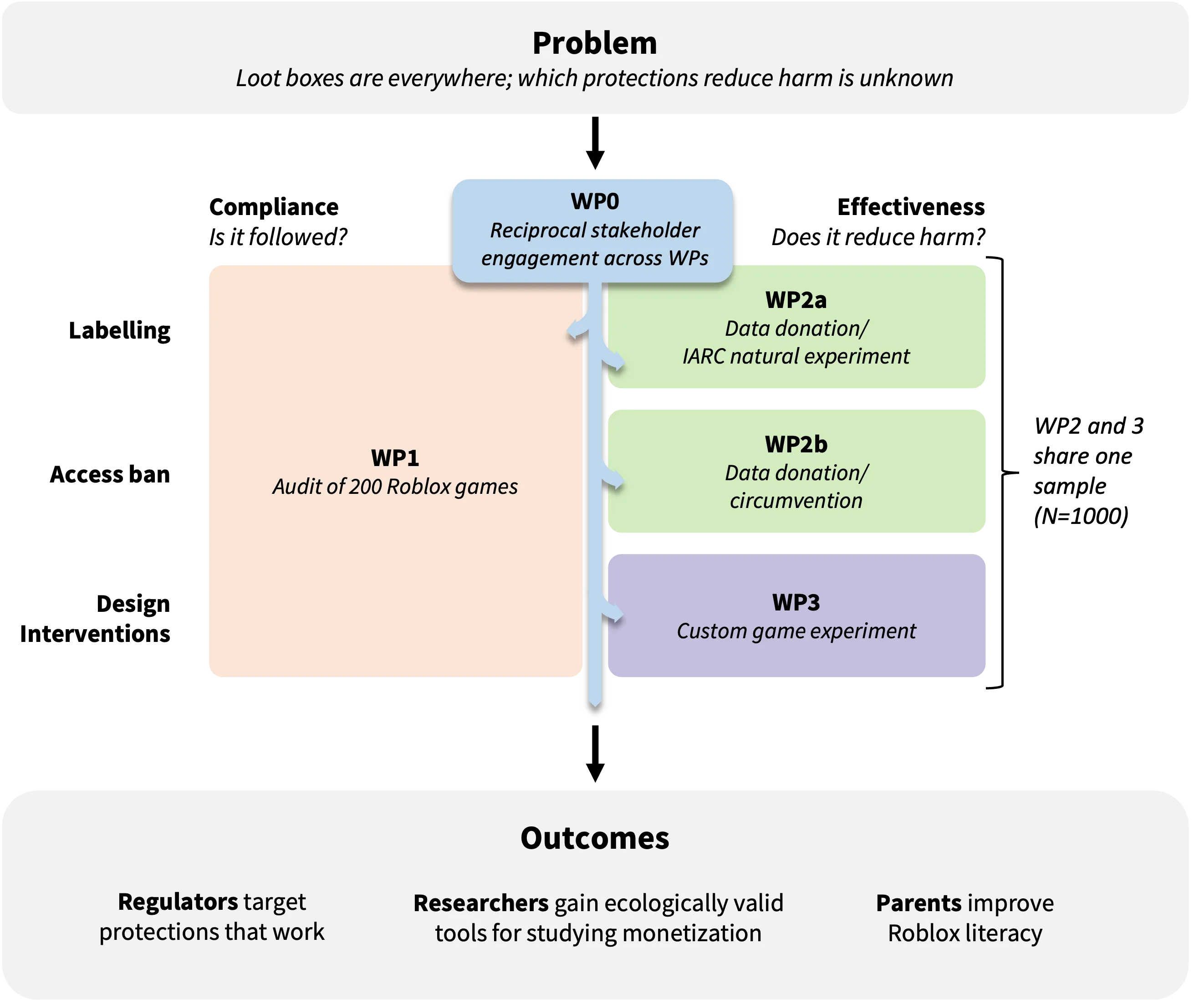
- An audit of 200+ Roblox games determines protection compliance: are loot boxes labelled, blocked for UK under-18s, and are the required odds actually shown?
- We use donated account history data to measure, for the first time, how many young people circumvent under-18 ban, the harms they experience in doing so, and whether a new labelling system changes that.
- We build a real Roblox game with realistic spending conditions to test which design feature interventions reduce financial harms.
- Throughout, we work with young people, parents, regulators, game companies and researcher communities to translate findings into directly useful and usable guidance.
Together, this project is the first study of compliance and effectiveness of all protections, providing evidence on the effectiveness of differing regulatory regimes (including regulatory gaps and loopholes), and the impact of age ratings on preventing gambling-related harm.
Beneficiaries
UK and EU regulators and age rating bodies will receive clear guidance on regulatory gaps and effectiveness of different protections. Partnering with ParentZone, we will increase families’ literacy on loot box age ratings, labels, and parental controls on Roblox. Working with the Thriving in Games Group (consisting of hundreds of game companies, including Roblox), we will improve design guidance on loot box protections, potentially directly enhancing protections for millions of UK minors playing Roblox today. Finally, we empower games researchers to conduct rigorous data donation and Roblox-based research by openly sharing all data, code, and infrastructure.